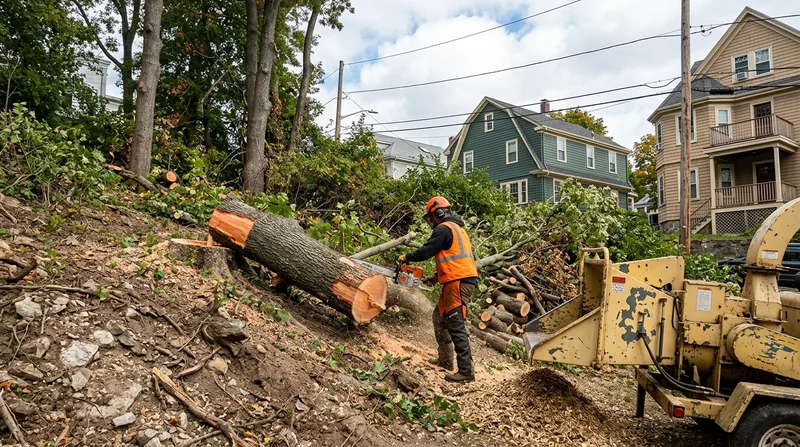




Land clearing in Boston means removing trees, brush, stumps, and debris from residential or light commercial lots to prepare land for construction, improve fire safety, or restore property lines. Greater Boston's terrain is glacial, rocky, and shallow-rooted, with dense canopies of Norway maples, red oaks, white pines, and hemlocks packed onto narrow triple-decker lots in Dorchester and Jamaica Plain, or spreading across larger wooded parcels in Newton and Brookline. When you need to clear land, you're fighting both the trees themselves and the shallow, ledgy soil that holds them. We handle lot clearing the way it actually works in Boston: fast, safe, compliant with local permits, and with full debris removal so your lot is ready to use.
Why Land Clearing Matters in Boston: Fire Safety, Construction, and Property Lines
Boston's dense residential neighborhoods and wooded suburbs face real fire risk, especially during dry late summer and early fall when hemlock and oak debris becomes tinder. Building permits in many Boston neighborhoods require cleared defensible space around new construction. Property lines in Jamaica Plain and Brookline often run through overgrown lots with decades of deadfall and invasive brush. Clearing a lot isn't cosmetic, it's a legal and safety requirement that protects your home, meets municipal code, and opens the land for actual use.
- Remove dead trees, hazard limbs, and brush that harbor pests and create fire load on your property.
- Meet fire marshal and building department requirements for defensible space around structures.
- Clear sight lines and access routes for construction, landscaping, or future development.
- Eliminate overgrown brush and invasive species that choke out usable yard space.
- Grind stumps and remove roots so the land is flat, safe, and ready to build or plant.
Each of these outcomes requires a different approach, but all of them start with a clear-eyed site assessment and a plan that respects Boston's permitting rules.
Key info: Many Boston neighborhoods, including Cambridge, Somerville, and Brookline, require a removal permit for trees above 8 to 12 inches in diameter. Some cities protect heritage oaks and elms. Check your city's zoning or arborist office before clearing, or call us at (857) 380-7444 and we'll handle the permit research.
For detailed information on Boston's tree and land clearing regulations, visit the City of Boston Parks and Recreation Department or your local city hall.
How We Clear Land in Boston: Step-by-Step Process
Our land clearing process starts with a site visit to map tree species, identify hazards, check for utility lines, and understand soil and access. We pull permits where required, stage equipment safely on tight Boston lots, and work systematically through the site with chainsaws, brush chippers, and debris removal. We don't leave stumps, roots, or piles on your property. When the job is done, your lot is clear, graded, and ready. We handle the entire job so you don't have to coordinate with multiple contractors.
- Schedule a free site visit and we assess tree size, species, access, and any permit requirements specific to your city.
- Obtain all necessary removal permits from your city or town before any work begins.
- Mark utility lines and plan equipment placement to avoid damage to structures, fences, and neighboring properties.
- Fell trees in sections, chip brush on-site or haul it away, and grind stumps below grade.
- Remove all debris, grade the lot, and leave the site clean and ready for your next project.
This methodical approach works on everything from a small Somerville backyard choked with invasive shrubs to a full residential lot in Newton ready for a new build.
Example: A homeowner in Brookline had a 0.25-acre lot overgrown with dead hemlocks, fallen oak limbs, and dense brush blocking the back property line. We cleared the canopy, chipped all brush, ground three stumps, and removed the debris in one day. The lot went from unusable to open and ready for landscaping. That's the standard we aim for on every job.
For more information on how we approach similar work, see our tree removal service page.
Land Clearing Methods: Choosing the Right Approach for Your Boston Lot
| Approach | Description | Best for |
|---|---|---|
| Selective removal | Take down hazard trees and dead limbs while preserving mature oaks, elms, or pines that add value and shade. | Residential lots in Jamaica Plain or Brookline where you want to keep heritage trees but clear the understory. |
| Clear-cut with stump grinding | Remove all trees and brush, grind stumps and roots below grade, and haul debris off-site for full lot access. | Construction sites, fire mitigation, or lots so overgrown that selective work is not practical. |
| Brush and invasive removal | Cut and chip dense brush, multiflora rose, buckthorn, and invasive shrubs without removing large standing trees. | Property line restoration, fire defensible space, or lots where you want to open the understory without major tree work. |
| Debris removal and hauling | Clear fallen limbs, deadfall, old construction debris, and brush piles left from previous work or storms. | Post-storm cleanup, inherited overgrown properties, or lots with years of accumulated deadfall and junk. |
Every lot in Boston is different. What works for a dense triple-decker in Dorchester won't work for a wooded 1-acre parcel in Needham. We assess your specific situation and recommend the method that gets the job done safely, legally, and within budget.
Land Clearing Cost in Boston: What to Expect
Land clearing cost in Boston ranges from a few hundred dollars for small brush removal to several thousand for a full lot clear with stump grinding and debris haul. The price depends on tree size and species, number of trees, brush density, access for equipment, proximity to structures and utility lines, whether permits are required, and whether stumps need to be ground. A typical residential lot clear in Boston runs $1,500 to $4,500. Larger properties, dense woodland, or sites with limited access cost more. Get a free estimate and we'll give you a real number based on your lot.
Factors that move the cost up include large mature oaks or pines (more time, more debris), multiple trees close to the house or power lines (slower, more careful work), shallow rocky soil that makes stump grinding harder, and permit requirements that add paperwork and scheduling. If your lot is small, accessible, and has only a few small trees, you'll be at the lower end. If you're clearing a full acre of dense woodland with multiple large trees and limited equipment access, you'll be at the higher end or beyond.
We always recommend getting 2 to 3 estimates before you book. Make sure each contractor is insured, and clear about what's included: debris removal, stump grinding, grading, and site cleanup. Cheap estimates often don't include hauling, which leaves you with piles to deal with yourself. Our pricing includes the full job, no surprises.
See our full pricing page for more detail on how we structure estimates and what affects the final bill.
What to Look for When Hiring a Tree Service Near Me: Boston Homeowner Checklist
When you're looking for a land clearing contractor near Boston, you're making a decision that affects your safety, your property value, and your wallet. Start by checking that the company is fully insured. In Massachusetts, tree service contractors must hold a license. Call your city hall or check the state contractor board to verify. Ask for proof of general liability and workers' compensation insurance. If the contractor gets hurt on your property or damages your neighbor's fence, that insurance protects you.
Second, get multiple estimates. Three is the standard. Each estimate should be on-site, detailed, and free. If someone quotes over the phone without seeing the lot, they're guessing. Ask what's included: debris hauling, stump grinding, grading, permit fees. Ask about references from recent jobs in your city. Call them. A contractor who did good work in Newton or Cambridge will do good work on your lot.
Third, understand permits. If your city requires a removal permit (most do for trees over 8 to 12 inches), the contractor should pull it or explain why it's not needed. Ask about heritage tree protections. Boston and Brookline protect certain oaks and elms. If your lot has protected trees, a good contractor knows the rules and can work within them. Finally, if you're in an HOA community, check your covenants. Some require approval for visible tree work.
- Verify the contractor holds a current Massachusetts tree service license and carries general liability and workers' compensation insurance.
- Get at least three on-site estimates that detail what's included, what's not, and the final price.
- Ask for references from recent jobs in Boston, Cambridge, Somerville, or your specific neighborhood.
- Confirm that the contractor understands your city's permit requirements and will obtain them before starting work.
- Check for heritage tree protections or HOA restrictions on your property before scheduling.
- Ask about equipment staging, site access, and how long the job will take.
A professional contractor will answer every one of these questions clearly and without pressure. If you're ready to move forward, contact us for a free estimate at (857) 380-7444.
Land Clearing in Boston: Pricing Guide
| Service | Price | Details |
|---|---|---|
| Small lot clearing | Starting at $800 | Removal of 2-4 small trees, brush chipping, and basic debris removal from residential lot |
| Standard residential lot | Starting at $2,000 | Clear 5-8 trees, stump grinding, brush removal, and full debris haul for typical Boston residential property |
| Large lot or woodland | Starting at $4,500 | Multiple large trees, dense brush, limited access, extensive stump work, or full acre-plus clearing projects |
| Estimate | Free | On-site visit within 24 hours, detailed quote, no obligation, call (857) 380-7444 |
| Debris hauling | Included | All brush, logs, and debris removed from site as part of standard clearing contract price |
Indicative pricing, the exact cost depends on square footage, finish, and site access. Free personalized estimate within 24h at (857) 380-7444.


