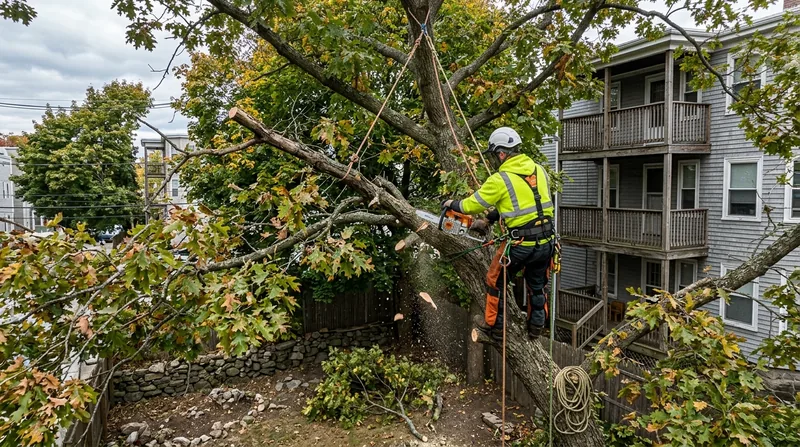




Tree trimming and pruning in Boston keeps Norway maples, red oaks, and white pines healthy while preventing limb failure on overhead wires and roof lines. Boston's glacial terrain, shallow rocky soil, and exposure to nor'easters, ice storms, and heavy wet spring snow create real structural stress on trees crowded onto triple-decker lots in Dorchester, Jamaica Plain, and Roslindale, as well as Victorian and Colonial Revival homes on tight tree-lined streets in Brookline, Newton, and the inner suburbs. Proper pruning removes deadwood, thins crowns to reduce wind load, and clears branches away from gutters, siding, and power lines before a storm brings them down. Our experienced arborists assess each tree's species, age, and structural condition to remove only what needs to come out, improving both health and safety without over-cutting. We work year-round in Boston, Cambridge, Somerville, Quincy, and surrounding towns.
Why Tree Trimming and Pruning Matters on Boston's Crowded Lots
Trees in Boston neighborhoods face constant pressure. Dense housing stock means trees grow close to houses, garages, and fences. Glacial soil keeps roots shallow, making trees vulnerable to wind and ice loading. Hemlock woolly adelgid is thinning our hemlock canopy, ash trees are failing to emerald ash borer, and recent spongy moth defoliation has left oaks weakened and prone to branch drop. A single heavy limb landing on a back porch, gutter, or power line creates liability, damage, and emergency repair costs that far exceed preventive pruning.
- We remove dead, diseased, and crossing branches that weaken structure and invite pest infestation.
- Crown thinning reduces wind resistance and ice loading during spring nor'easters and winter storms.
- Clearance pruning lifts low branches away from roofs, chimneys, gutters, and overhead power lines.
- Structural pruning establishes a strong branch framework that lasts decades and reduces future storm damage.
- Early intervention on trees showing dieback or bark damage prevents rapid decline and sudden failure.
Routine pruning every 3 to 5 years keeps mature trees safe and extends their life, protecting both your property and your neighbors' in tightly built neighborhoods.
Local reality: A 40-foot Norway maple overhanging a triple-decker in Jamaica Plain or a white pine on a wooded lot in Newton can drop a 60-pound limb without warning. Ice storms and wet spring snow add 400 pounds per square inch of load. Thinning the crown by 15 to 20 percent cuts wind resistance and ice accumulation dramatically. Check your local city ordinances before removing limbs on property lines, heritage trees, or trees in HOA-governed neighborhoods.
How We Trim and Prune Trees in Boston: A Step-by-Step Process
We start with an on-site assessment. Our arborists examine the tree's species, age, overall health, and structural defects. We identify branches that are dead, diseased, rubbing, crossing, or growing toward structures. We check for signs of pest damage, canker, or decline. Then we develop a pruning plan that removes only what needs to come out, maintains the tree's natural form, and improves its long-term structure and safety.
- We inspect the tree for dead wood, disease, and structural weak points before making any cuts.
- We remove all deadwood, diseased branches, and branches that cross or rub together.
- We thin the crown evenly to improve light penetration, air flow, and storm resistance.
- We clear low branches and branches near power lines, gutters, and roof lines as needed.
- We make proper cuts just outside the branch collar to promote rapid healing and prevent disease entry.
- We haul all brush and limbs off-site or chip them for mulch, leaving your yard clean.
The entire process follows best practices for tree health. We never top trees, never remove more than 25 percent of the live crown, and never leave stubs. A mature red oak or linden in Brookline or a tall white pine in Newton can take 2 to 4 hours depending on size, access, and density. For details on our emergency response for storm-damaged trees, call us at (857) 380-7444.
Example job: A 50-foot Norway maple in Somerville with dense crown, three large dead branches, and one limb hanging over the neighbor's deck. We remove the dead wood, thin the crown by 20 percent, and clear the overhanging branch. Cost starts at $450 to $650 depending on access and chip hauling. A smaller 30-foot maple on a tight lot in the South End with just deadwood and light thinning runs $250 to $350. Get a free estimate at Boston Tree Service.
Trimming Methods and Approaches
| Approach | Description | Best for |
|---|---|---|
| Deadwood Removal | Cut out all dead, diseased, or broken branches flush with the branch collar to prevent disease entry and pest infestation. | Trees showing bark damage, canker, or limbs that snap easily in your hands. |
| Crown Thinning | Selectively remove branches throughout the crown to improve light, air flow, and structural strength without changing the tree's overall shape. | Mature oaks, maples, and pines in Boston neighborhoods where wind and ice loading are high. |
| Clearance Pruning | Remove branches that overhang roofs, gutters, power lines, or neighboring property to eliminate hazard and improve sightlines. | Trees on tight lots in Jamaica Plain, South End, or Brookline where branches touch structures or cross property lines. |
| Structural Pruning | Remove crossing, rubbing, or poorly angled branches to establish a strong framework with one central leader and well-spaced primary limbs. | Younger trees and trees showing weak crotch angles or multiple competing leaders prone to splitting. |
| Hedge and Shrub Trimming | Shape and maintain hedges, privet, and ornamental shrubs to promote dense growth, improve form, and control size. | Foundation plantings and property-line hedges in Newton, Dedham, and Wellesley where formal appearance matters. |
Each method targets a specific goal. Deadwood removal prevents disease and pest entry. Crown thinning prepares mature trees for storm season. Clearance pruning solves immediate safety and access problems. Structural pruning sets young trees up for long-term strength. We choose the right approach based on your tree's condition and your goals.
Tree Trimming and Pruning Cost in Boston: What to Expect
Pricing for tree trimming and pruning in Boston depends on tree size, species, crown density, access, proximity to structures, and the scope of work. A small deadwood removal on a 25-foot tree in an easy-access yard starts at $250 to $350. A medium crown thinning on a 40-foot maple or oak runs $400 to $700. Large trees with heavy deadwood, dense crowns, or tight access, or jobs requiring crane work, run $800 to $1,500 or more. Travel is included in all quotes within Boston and surrounding areas. We provide free estimates within 24 hours at (857) 380-7444.
Several factors move the price up. Tree height and crown size matter most. A 30-foot tree takes less time than a 60-foot tree. Proximity to power lines, gutters, or neighboring houses adds complexity and safety equipment. Tight lot access in triple-decker neighborhoods or back-yard work requires more rigging and manual labor. Species matters too. A dense Norway maple takes longer to thin than a more open red oak. Chip hauling and brush removal add cost if you don't want debris left on-site. For a detailed breakdown of pricing options, visit our pricing page.
The best approach is to get 2 to 3 free estimates from insured contractors. Each estimate should explain what work is included, why it's needed, and what it costs. Never hire based on price alone. A low bid often means less thorough work or inexperienced crews. A high bid may include unnecessary work. A middle estimate with clear explanation and verifiable references is usually the safest choice.
Tree Trimming and Pruning Near Me: What Boston Homeowners Should Know Before Hiring
Hiring the right tree service protects your property, your neighbors, and your liability. Before you call, verify that any contractor you're considering is fully insured in Massachusetts. Ask for proof of general liability coverage (minimum $1 million) and workers' compensation insurance. A licensed contractor carries a state contractor license and can show it on request. Check references from recent jobs in your neighborhood. Ask neighbors, friends, or your HOA for recommendations. In many Boston neighborhoods, property-line trees, heritage trees, and trees above a certain diameter require a removal or trimming permit from your city. Cambridge, Brookline, and Somerville have strict heritage tree ordinances. Your contractor should know local rules and help you navigate permits.
- Verify the contractor holds a current Massachusetts contractor license and can provide proof on demand.
- Request certificates of general liability insurance ($1 million minimum) and workers' compensation coverage.
- Get 2 to 3 written estimates that itemize the work, explain why it's needed, and state the cost clearly.
- Ask for references from jobs completed in Boston, Cambridge, or your specific neighborhood within the last 2 years.
- Check whether your city requires a permit for the work, especially if the tree is on a property line or in a protected heritage list.
- Confirm your HOA or neighborhood association has no restrictions on visible tree work before scheduling.
- Never hire a crew that shows up without a written estimate, insurance documentation, or a business phone number.
A professional contractor will spend 15 to 30 minutes on-site, ask detailed questions about your goals, and provide a written estimate before any work begins. If they rush or pressure you to sign immediately, walk away. For a free, no-obligation estimate from Boston Tree Service, contact us today or call (857) 380-7444. We're insured, and ready to help.
Tree Trimming & Pruning in Boston: Pricing Guide
| Service | Price | Details |
|---|---|---|
| Small deadwood removal and light thinning | Starting at $250 | Trees 25 to 30 feet tall with minimal deadwood and simple access, includes cleanup and chip hauling |
| Medium crown thinning and clearance pruning | Starting at $400 | Trees 35 to 50 feet, moderate crown density, some deadwood, and standard residential access with basic rigging |
| Large or complex pruning jobs | Starting at $800 | Trees over 50 feet, dense crowns, heavy deadwood, tight access, proximity to power lines or structures requiring specialized equipment |
| Chip hauling and debris removal | Included | All brush and limbs removed from site or chipped on-site at no additional charge within Boston service area |
| Free estimate | No charge | On-site assessment, written quote, and no-obligation booking within 24 hours by phone at (857) 380-7444 |
Indicative pricing, the exact cost depends on square footage, finish, and site access. Free personalized estimate within 24h at (857) 380-7444.


